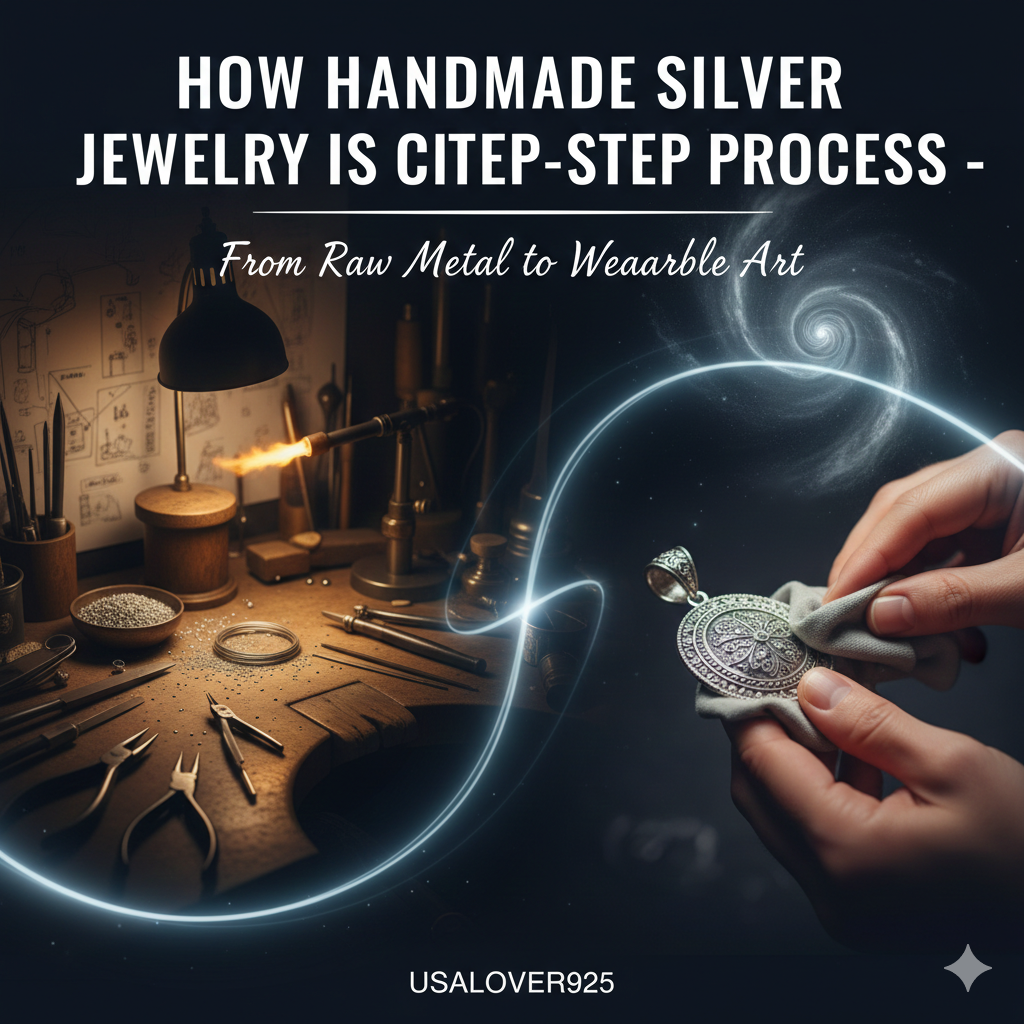
How Handmade Silver Jewelry is Created – Step-by-Step Process
Handmade silver jewelry transforms raw sterling silver into timeless treasures through skilled artisan hands. Unlike mass-produced pieces, handmade silver jewelry carries unique imperfections, stories, and energy—perfect for solitaire rings or eternity ring bands at Usalover925.com.
This 2600-word guide breaks down the handmade silver jewelry process step-by-step, from design sketches to final polish. Drawing from traditional techniques used by Balinese smiths and modern jewelers, you’ll see why our unisex bands and pendants shine with authenticity. Ready to peek behind the bench?
Why Choose Handmade Silver Jewelry Over Mass-Produced?
Handmade silver jewelry (92.5% pure sterling) offers superior quality: hand-forged details, ethical sourcing, and customization. Mass items use dies, lacking soul—handcrafting allows granulation, texturing, and gem settings unique to each piece.
Benefits include hypoallergenic purity, heirloom durability, and chakra-aligned energies. At usalover925.com, every women’s ring embodies this craft. Follow our Instagram for live making sessions.
Tools and Materials for Handmade Silver Jewelry
Artisans need precision gear:
Silver Sheet/Wire: 92.5% sterling blocks melted into sheets or drawn via rolling machines.
Jeweler’s Saw: Fine blades for intricate cuts.
Files/Pliers: Needle files, round/chain-nose pliers for shaping.
Torch/Soldering Kit: Butane torch, silver solder (lower melt point alloy), flux.
Polishing Wheels: Tripoli rouge, buffing cloths.
Gems/Settings: Prong/bezel for men’s gemstone rings.
Safety: Ventilation, gloves, fireproof bench. Cost for basics: $200-500.
Step 1: Design and Prototyping
Handmade silver jewelry starts with inspiration—sketches or CAD for complex signet rings. Artisans draw motifs, considering wearability and symbolism (e.g., eternity loops).
Rapid Prototyping: Wax or 3D print models for testing.
Client Input: Custom engravings via apps.
Cultural Touches: Balinese granulation or Indian filigree.
Time: 1-3 days. Our YouTube shows design evolutions.
Step 2: Preparing the Silver – Melting and Forming
Raw silver ingots (99.9% pure) alloy with copper for sterling strength. Melt in crucibles at 960°C, pour into molds: square for sheets, round for wire.
Wire Drawing: Feed through progressively smaller drawplates (like pasta makers).
Sheet Rolling: Compress blocks via rolling mills to 0.5-2mm thickness.
Annealing: Heat to 650°C to soften for bending, preventing cracks.
This yields flexible stock for unisex rings.
Step 3: Sawing and Cutting Shapes
Lubricate saw blade with beeswax, pierce metal sheet for outlines. Jeweler’s saw cuts precise curves for band shanks or pendant drops.
Piercing: Drill starter holes, follow patterns.
Safety: Clamp in bench pin, steady hands.
Waste Recycling: Melt scraps back into ingots.
For a solitaire ring, saw prong seats. Precision here defines handmade silver jewelry elegance.
Step 4: Filing, Sanding, and Shaping
Rough edges vanish under files: flat for straights, half-round for curves. Progress to emery paper (400-2000 grit) for smoothness.
Forging/Hammering: Texture with ball peen hammers or stamps.
Dapping/Doming: Press into blocks for curved surfaces.
Forming: Bend wire into loops with pliers.
Shaping takes 2-4 hours per piece, creating ergonomic eternity ring bands.
| Step | Tools | Time per Piece | Common for |
|---|---|---|---|
| Sawing | Jeweler’s saw, beeswax | 30-60 min | All shapes |
| Filing | Needle files, sandpaper | 1-2 hrs | Edges/refinement |
| Shaping | Pliers, hammers | 1-3 hrs | Bands/pendants |
Step 5: Soldering and Assembly
Join seams with silver solder (easy/medium/hard grades). Apply flux, heat evenly with torch until solder flows—no melting the base!
Pickle Bath: Citric acid dip removes oxidation (firescale).
Assembly: Link chains, set mechanisms for clasps.
Granulation: Solder tiny silver balls for texture (Balinese style).
Critical for pendant/necklace chains. Practice prevents weak joints.
Step 6: Stone Setting and Embellishments
Secure gems in prongs, bezels, or pavé. For men’s gemstone ring:
Prong Setting: Bend tines over stone with pusher.
Bezel: Push walls tight with punch.
Engraving: Hand tools for motifs.
Adhesives rare in quality handmade silver jewelry.
Step 7: Polishing, Finishing, and Plating
Final shine via tumblers or buffing wheels with rouge compounds.
Texturing: Liver of sulfur for patina.
Polishing Stages: Tripoli (cut), white diamond (shine).
Rhodium Plating: Electroplate for tarnish resistance (optional).
Buff to mirror finish—hallmark of usalover925 pieces.
Step 8: Quality Control and Hallmarking
Inspect for symmetry, secure settings, weight. Stamp “925” for sterling purity. Ethical checks: no child labor, sustainable sourcing.
Packaging: Velvet boxes with certificates.
Time, Cost, and Skill Levels in Handmade Silver Jewelry
Beginner Piece (Ring): 4-8 hours, $20-50 materials.
Complex Pendant: 20+ hours, $100+.
Artisan Rate: $30-80/hour.
Scaling production? Small teams like ours at usalover925.com blend handcraft with efficiency.
Common Challenges and Pro Tips
Firescale: Prevent with pickle soaks.
Tarnish: Store in anti-tarnish strips.
Scaling Up: Templates speed prototypes.
Watch Pinterest tutorials for demos.
Sustainability in Handmade Silver Jewelry Crafting
Recycle 90% scraps; use recycled silver. Low-waste vs. factory stamping. Our gems are conflict-free.
Shop Our Handmade Silver Jewelry Collections
Experience the process in every piece:
Visit More Category Of Product:
FAQs: Handmade Silver Jewelry Process
How long does handmade silver jewelry take?
4-20 hours per piece, depending on complexity.
Is 925 silver real for handmade jewelry?
Yes, 92.5% pure—hallmarked standard.
Can I customize handmade silver jewelry?
Absolutely—engravings, gems via our site.
How to care for handmade silver jewelry?
Polish monthly; avoid perfumes.
Craft your legacy with handmade silver jewelry—shop usalover925.com today!