Introduction: The Hidden Truth Behind Gemstones
Gemstones are among nature’s most beautiful creations — each one unique, full of color, and believed to hold spiritual or emotional power. From royal crowns to everyday rings, gemstone jewelry has captivated hearts for centuries. www.usalover925.com
But in today’s global jewelry market, not every “gem” is what it seems. Synthetic stones, glass imitations, and treated gems have flooded the market, making it harder for buyers to distinguish between real and fake gemstones.
If you’ve ever wondered whether your gemstone is authentic or imitation, this detailed guide will teach you how to identify real vs fake gemstones in jewelry, what to look for, and how to protect yourself from being misled.
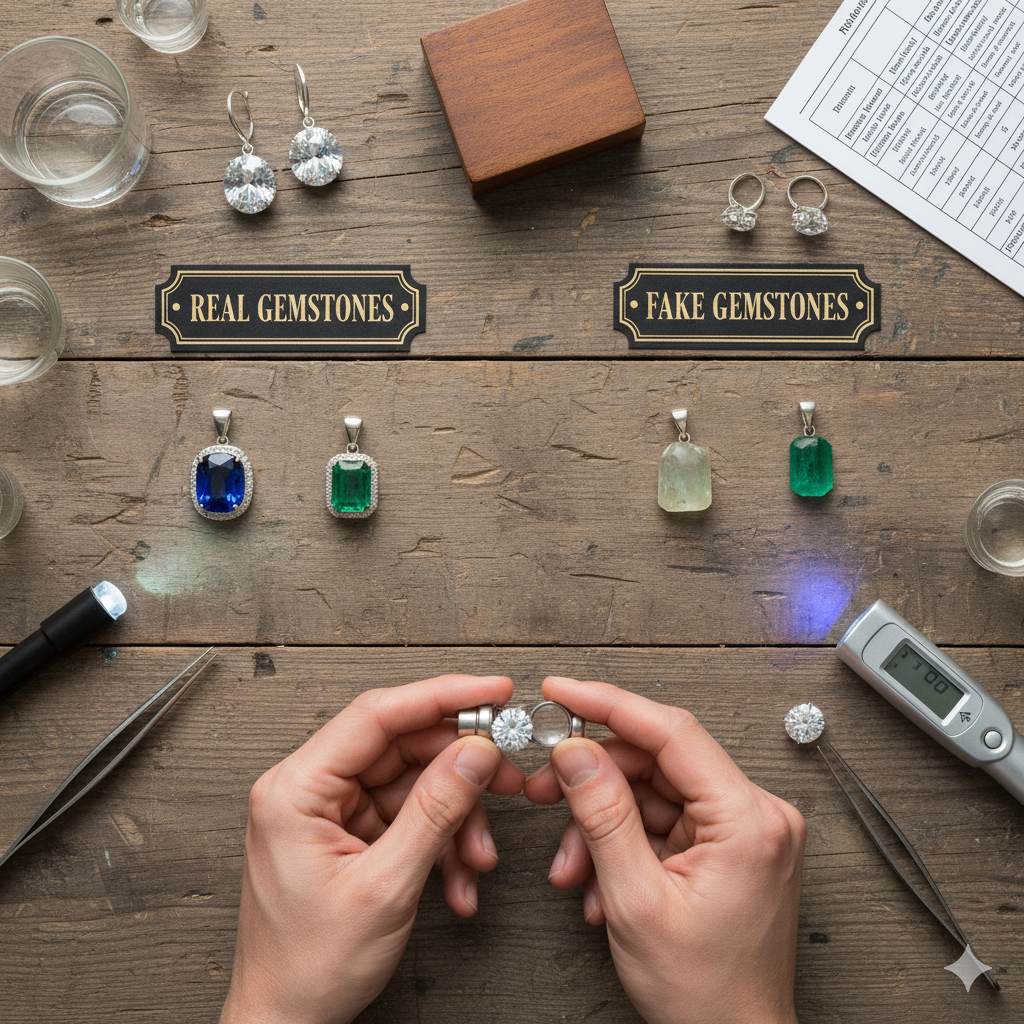
💠 What Are Real Gemstones?
Real gemstones are naturally formed in the earth over millions of years. These stones undergo cutting and polishing but retain their natural structure and inclusions — tiny imperfections that prove authenticity.
🔹 Key Features of Real Gemstones:
Natural inclusions (tiny bubbles, lines, or mineral traces)
Unique color tones (not perfectly uniform)
Cool to the touch and heavy in hand
Durability and brilliance that last for years
Each real gemstone — like sapphire, ruby, emerald, or amethyst — carries distinct properties that make it valuable and meaningful.
💠 What Are Fake or Imitation Gemstones?
Fake gemstones are man-made or altered materials designed to mimic real gems. These may include:
Glass
Plastic resin
Synthetic crystals (like cubic zirconia)
Lab-grown gemstones (chemically identical but not natural)
While some imitations look stunning, they lack natural imperfections and authenticity — making them cheaper and less valuable.
⚖️ Types of Fake Gemstones You Should Know
| Type | Description | Example |
|---|---|---|
| Glass Imitations | Colored glass molded to look like gems | “Ruby glass,” “emerald glass” |
| Synthetic Stones | Created in labs, identical in composition | Lab-created sapphire |
| Composite Stones | Real gem fragments fused with resin or glass | “Doublets” and “triplets” |
| Simulants | Different material made to look similar | Cubic zirconia, spinel |
| Dyed or Treated Stones | Color enhanced artificially | Dyed quartz, heat-treated topaz |
🔍 How to Identify Real vs Fake Gemstones in Jewelry
Below are 10 professional-level tests and techniques to identify authentic gemstones from fake ones — both at home and with expert help.
1️⃣ Check the Weight
Real gemstones are denser and heavier than their fake counterparts.
Hold the gem in your palm — if it feels unusually light, it may be glass or plastic.
For example, a real sapphire feels heavier than a glass sapphire imitation of the same size.
💡 Pro Tip: Use a jeweler’s balance scale for precise comparison.
2️⃣ Observe the Color and Clarity
Real stones have natural color variation — slightly uneven or deeper tones.
Fake stones look too perfect, with flat or uniform coloring.
Example: Real emeralds often show fine inclusions (called “jardin”), while fake emeralds appear flawlessly green.
3️⃣ Inspect for Inclusions Under Magnification
Using a 10x jeweler’s loupe, look closely at the gem:
Real gems usually contain tiny inclusions — minerals, bubbles, or feather-like lines.
Fake stones appear too clean or flawless, showing bubbles or mold marks if made of glass.
🧠 Remember: Perfection in gemstones often means imitation.
4️⃣ Touch and Temperature Test
Natural gemstones are cool to the touch — they take longer to warm up in your hand.
Plastic or glass imitations feel warm almost instantly.
✅ This is an easy at-home test for stones like amethyst, garnet, and topaz.
5️⃣ Check Light Reflection and Sparkle
Real gemstones reflect light in complex patterns and show deep brilliance.
Fake gemstones may sparkle excessively or have a glassy shine.
Example:
A real diamond reflects white and rainbow-colored light beautifully.
A cubic zirconia reflects mostly rainbow colors, appearing “too sparkly.”
6️⃣ Hardness Test (Mohs Scale)
Every gemstone has a specific hardness on the Mohs scale (1–10).
Diamond – 10
Sapphire/Ruby – 9
Quartz – 7
Opal – 5–6
If your stone scratches easily with a pin, it’s likely not genuine.
⚠️ Caution: Do not scratch-test valuable jewelry directly — use a similar piece or consult a jeweler.
7️⃣ Check for Air Bubbles
Hold the gemstone under bright light or a magnifier:
Glass fakes often contain round air bubbles trapped inside.
Natural gems rarely have such uniform bubbles.
Example: If you spot bubbles in a “ruby,” it’s almost certainly glass.
8️⃣ Look at the Mounting and Metal
Authentic gemstones are usually set in high-quality metals like 925 Sterling Silver, gold, or platinum.
If the jewelry base is cheap metal, it’s likely the gemstone is fake too.
💎 At USALover925.com, we use only authentic gemstones set in hallmarked 925 sterling silver.
9️⃣ Refractive Index (RI) Test
Each gemstone bends light differently — this property is called refractive index.
Real gemstones have consistent RI values measurable with a gem refractometer.
Fakes usually don’t match known values for that gem type.
This is an advanced gemologist test but extremely reliable.
🔟 Get a Professional Gem Certification
The ultimate proof of authenticity is a certificate from a trusted gemological lab.
Reputed labs include:
GIA (Gemological Institute of America)
IGI (International Gemological Institute)
GSI (Gemological Science International)
Always ask your jeweler for certification — especially for expensive gems like sapphire, ruby, or emerald.
💎 Real vs Fake Gemstones: Quick Comparison Table
| Feature | Real Gemstones | Fake Gemstones |
|---|---|---|
| Origin | Natural (earth-formed) | Synthetic or artificial |
| Color | Slight variations | Uniform or too bright |
| Clarity | Natural inclusions | Bubbles, mold marks |
| Temperature | Cool to touch | Warms up fast |
| Weight | Heavier | Lighter |
| Durability | Hard (5–10 Mohs) | Soft or brittle |
| Metal Setting | 925 Silver / Gold | Alloy / plated metal |
| Certification | Available | Often missing |
🧭 Commonly Faked Gemstones
| Gemstone | Common Fake | How to Identify |
|---|---|---|
| Ruby | Red glass, synthetic spinel | Look for inclusions; real ruby glows deep red under UV light |
| Emerald | Dyed quartz or glass | Natural emeralds have garden-like inclusions |
| Sapphire | Synthetic corundum | Real sapphire has color zoning |
| Amethyst | Dyed quartz | Real amethyst has uneven purple tones |
| Topaz | Glass or coated quartz | Real topaz is heavier and clearer |
| Diamond | Cubic zirconia, moissanite | Real diamonds resist fog and scratch glass easily |
🧼 How to Maintain the Beauty of Your Real Gemstones
Clean gently with a soft brush and mild soap.
Avoid chemicals like perfume or bleach.
Store separately in soft pouches to prevent scratches.
Polish silver settings regularly to avoid tarnish.
Avoid direct sunlight for gems like amethyst and opal.
👉 Learn more in our guide: How to Clean & Care for Sterling Silver Jewelry at Home.
💠 Why Real Gemstones Are Worth It
Natural energy & healing properties
Long-term durability
Investment value
Unique natural beauty
Emotional connection — knowing your piece is one of a kind
Fake stones may shine for a while, but real gemstones hold timeless beauty and lasting worth.
🌍 Ethical Gemstone Sourcing
At USALover925, we believe in ethical and sustainable jewelry.
Our gemstones are responsibly sourced, handcrafted, and set in 925 sterling silver, ensuring every piece tells a story of authenticity and craftsmanship.
💎 Explore: www.usalover925.com